
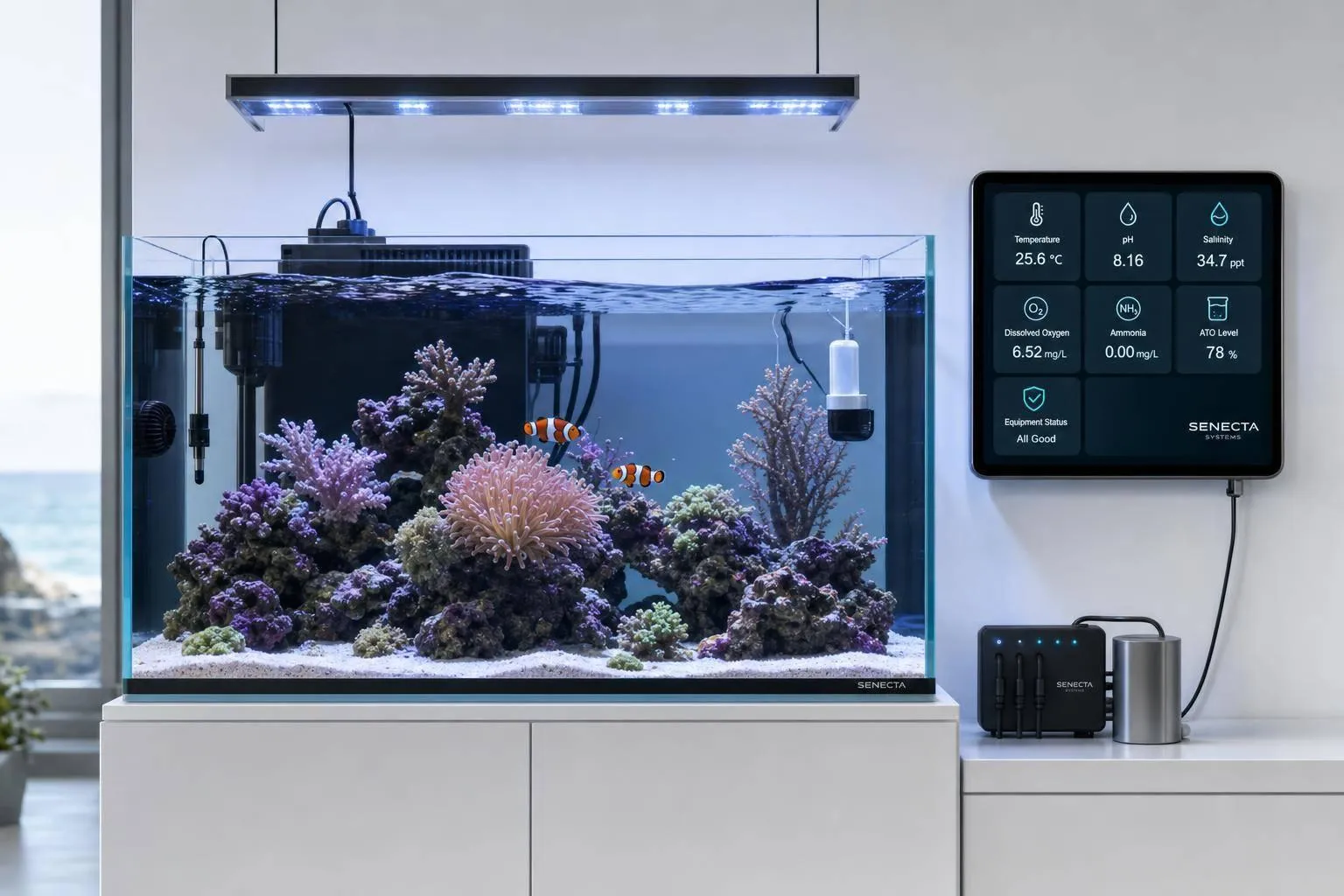
Most tank problems start small, then get expensive fast. If I had to keep only one habit, I’d check temperature, pH, salinity or conductivity, dissolved oxygen, water level/ATO activity, ammonia, and equipment status every day.
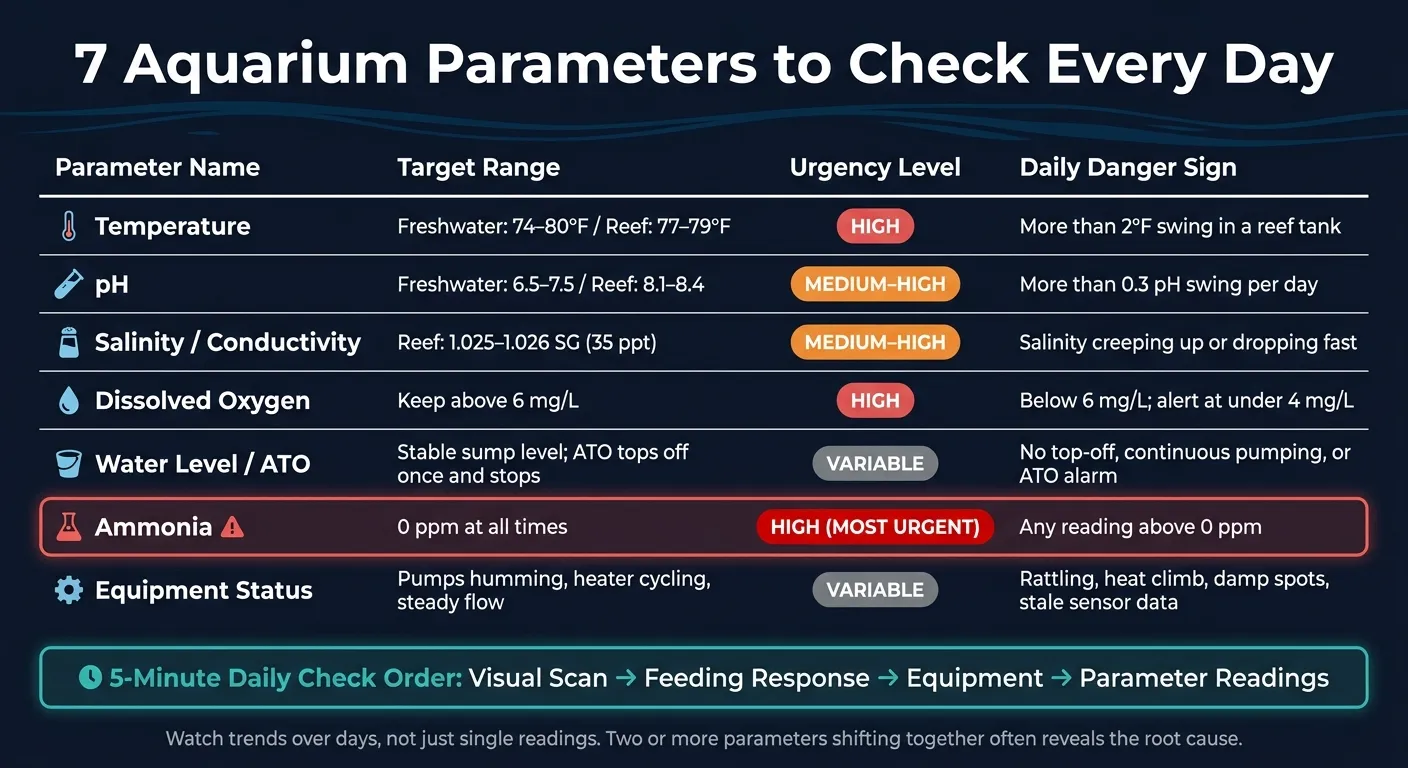
Here’s the short version: temperature swings, any ammonia above 0 ppm, low oxygen, and ATO mistakes can hurt fish or corals within hours. A daily check helps me catch drift before it turns into dead livestock, pump damage, or floor leaks. For reef tanks, I’d keep salinity at 35 ppt or 1.025–1.026 SG, temperature around 77–79°F, and watch for pH swings over 0.3. For freshwater tropical tanks, I’d keep temperature at 74–80°F and treat any ammonia reading above 0 ppm as a problem.
What I’d check each day:
- Temperature: drift, heater trouble, room heat issues
- pH: day-to-day swing and CO₂ problems
- Salinity or conductivity: evaporation, top-off mistakes, mineral buildup
- Dissolved oxygen: low gas exchange, heat stress, weak flow
- Water level / ATO activity: leaks, empty reservoir, stuck sensor
- Ammonia: waste spikes, dead livestock, filter trouble
- Equipment status: pump noise, heater light, flow loss, leaks
Quick Comparison
Parameter | What I’m watching for | Daily danger sign |
|---|---|---|
Temperature | Heater/chiller drift | More than 2°F swing in a reef |
pH | CO₂ and KH swing | More than 0.3 pH swing |
Salinity / Conductivity | Evaporation or top-off error | Salinity creeping up or dropping fast |
Dissolved Oxygen | Gas exchange and heat stress | Below 6 mg/L; under 4 mg/L is alert level |
Water Level / ATO | Reservoir, sensor, leak issues | No top-off, nonstop top-off, falling sump level |
Ammonia | Biofilter overload or crash | Anything above 0 ppm |
Equipment Status | Pump, heater, sensor, light issues | Rattling, stale data, heat climb, damp spots |
The main idea is simple: don’t just look for bad numbers. I’d watch patterns across a few days, because that’s where tank trouble usually shows up first.
Budget Reef Tank Monitor: Kactoily 7 in 1 Aquarium Wifi Monitor Review
https://www.youtube.com/embed/GJCix6bhhNg
What Makes a Parameter Worth Checking Every Day
Not every water quality reading needs a daily test. Some changes happen slowly. Nitrate and phosphate, for example, usually build up over days or weeks, so a weekly check is often enough.
The bigger issue is speed. Can this parameter shift fast enough to hide a problem before your next test?
That’s why it helps to watch trends, not just one-off numbers. A pH drop from 8.1 to 7.7 over a few days points to a problem that a once-a-week test could easily miss [11]. Temperature works the same way. Even a small change over several days can act like an early warning sign, hinting that water chemistry trouble may be coming next [11].
Some readings deserve daily attention because a missed swing can hurt livestock fast. Ammonia is the clearest case. It can become toxic at levels as low as 0.25 ppm [3], and in a stocked tank, any detectable amount should be treated like an emergency [4]. Dissolved oxygen can also fall in a hurry when water gets warmer or surface agitation drops. At 80°F, fish may need much more surface movement than they do at 72°F just to breathe without stress [3]. And if a heater sticks in the “on” position, water can hit lethal temperatures within hours [1][2].
All measurements below use U.S. units: °F, gal, ppm/mg/L, and ppt or specific gravity for reef salinity. For reef tanks, use 35 ppt or 1.025–1.026 specific gravity, depending on the sensor or test method [10][7].
The table below sums up how urgent each parameter is and what it tends to point to.
Parameter | Urgency | What It Signals |
|---|---|---|
Ammonia | High | Biofilter crash or overload |
Dissolved Oxygen | High | Temperature spike, poor flow, overstocking |
Temperature | High | Heater failure, chiller failure |
pH | Medium–High | CO₂ imbalance, alkalinity drift, algae stress |
Salinity / Conductivity | Medium–High | Evaporation buildup, ATO failure |
Water Level / ATO Activity | Variable | Leaks, evaporation rate changes, pump dry-run risk |
Equipment Status | Variable | Pump blockage, heater malfunction |
Temperature comes first as a daily check because it often shows system failure before any other reading does.
1. Temperature
Temperature touches almost everything in an aquarium. It affects metabolism, oxygen in the water, and bacterial activity. That’s why even small day-to-day drift matters. It can also flag heater, chiller, room-condition, and sensor issues before fish or corals show stress, which makes it one of the best early-warning readings to watch.
For most freshwater tropical tanks, keep water at 74–80°F. For reef tanks, aim for 77–79°F. In reefs, a daily swing of more than 2°F is a stress signal. Temperatures above 82°F increase bleaching risk, while temperatures below 75°F can weaken immune function in tropical species [6][7].
The most common day-to-day warning signs are pretty simple:
- A heater stuck on
- A heater stuck off
- Two probes giving different readings [1]
Summer heatwaves, changes in room air conditioning, and heat from lighting can also move tank temperature faster than a standard heater can keep up with [6][1].
Use a digital probe thermometer, not the heater dial or a stick-on strip. Those don’t show the actual water temperature [6]. If a reading seems off, compare it with a second thermometer before you change anything. Sensors can drift or fail, and a bad reading can send you in the wrong direction [1][6]. Log each reading and set alerts for steady drift or a probe mismatch. If it’s a true emergency, move fast. If not, make changes slowly so you don’t shock the tank with a sudden temperature swing [7].
Once temperature is steady, pH is the next daily check because it can move just as fast.
2. pH
pH tells you how acidic or alkaline your water is. In aquariums, it rises and falls with the day-night CO₂ cycle [6][12]. During the day, plants and corals use CO₂ for photosynthesis, which pushes pH up. At night, respiration adds CO₂ back into the water, which pulls pH down [6][12]. That up-and-down pattern each day is normal.
What matters most is stability, not chasing one perfect number. Most freshwater tanks sit around 6.5–7.5, mixed reefs 8.1–8.3, SPS reefs 8.2–8.4, and African cichlids 8.0–8.4. If your daily swing goes above 0.3 pH units, it’s worth digging into. The usual causes are poor gas exchange, low KH, or a high waste load [6][3][12].
If you use a liquid test kit, test at the same time every day so your readings line up. A good target is about 2 hours after the lights turn on [6]. That gives you a fair apples-to-apples check. If you want to track the full pattern, a digital probe can show the whole daily curve instead of one single snapshot [6][3].
Before you reach for a buffer, check KH first. KH helps hold pH steady, and when KH is low, pH tends to bounce around [3][8]. If a reading looks off, test again before you change anything. Expired reagents, blue lighting, and probes that haven’t been calibrated can all throw off the result [6][13].
If low pH keeps coming back, look at gas exchange and indoor CO₂ before trying to force the number upward [6][7]. That’s often where the issue starts. And because pH also changes ammonia toxicity, unstable pH can turn into a livestock problem fast [11].
Once pH is steady, salinity or conductivity becomes the next thing to check each day, since evaporation and top-off mistakes tend to show up there fast.
3. Salinity or Conductivity
Salinity is the amount of salt in marine water. You’ll usually see it shown as specific gravity (SG) or parts per thousand (ppt). Conductivity is a fast stand-in for dissolved ions, and in freshwater tanks it’s often reported as TDS. In simple terms: track salinity in reef and marine tanks, and track conductivity in freshwater, planted, and shrimp setups [5][4].
For reef tanks, the goal is 1.025–1.026 SG (35 ppt) [10][12]. This is one of those numbers that can slip out of range faster than people expect. Evaporation removes fresh water but leaves the salt behind, so salinity creeps up over time. That’s why a daily check matters. It often catches top-off mistakes before they turn into a visible tank problem.
Keep an eye on the water line and your ATO behavior. A dropping sump or pump-chamber level usually means salinity is climbing. An ATO alarm, a pump running dry, or an empty reservoir should all be treated as warning signs. In many cases, ATO behavior shows leaks, stuck sensors, or reservoir trouble before livestock shows stress [1].
A sudden drop in salinity often points to too much top-off water, usually from a stuck ATO sensor. At that point, don’t guess. Check with a probe or refractometer to see whether the change is real or if the ATO system just misfired.
For manual marine checks, use a calibrated refractometer. Skip swing-arm hydrometers. They’re too inconsistent for tight marine control [10]. Digital pens and continuous probes are faster and easier to read, but they still need regular calibration [3].
In freshwater tanks, TDS targets depend on the species. Even so, a steady upward drift can signal mineral buildup or fertilizer accumulation [13][5][4]. That slow change is easy to miss unless you check every day, which is why conductivity earns a spot on the daily list.
If salinity is stable, the next daily check is dissolved oxygen, since heat and weak surface movement can push it down fast.
4. Dissolved Oxygen
Dissolved oxygen (DO) is the oxygen fish breathe, and low DO can turn into an emergency fast [3][6]. That’s why DO deserves a daily check, not a “just in case” test.
Try to keep DO above 6 mg/L. If it falls below 4 mg/L, you’re in alert territory [3]. Warm water holds less oxygen, so as temperature climbs, your tank needs more surface agitation [3]. Numbers help, but the tank itself tells the story too.
Fish behavior is often the first warning sign. Gasping at the surface, rapid breathing, lethargy, or gathering at the surface are all red flags [3][2][1]. If you can see distress, oxygen is already low. It also helps to watch for surface film or foam, since both can slow gas exchange [9]. On the equipment side, listen for a rattling air pump, weak wavemaker flow, or a stopped return pump [1][9]. A temperature alert on your aquarium controller is a practical way to catch trouble early, because rising heat is one of the most common triggers [3][1].
Keep an air stone ready. More surface agitation is the main way to improve oxygen exchange, and it matters even more during heat waves [3]. In planted tanks, fish behavior overnight is often the earliest clue [3][6].
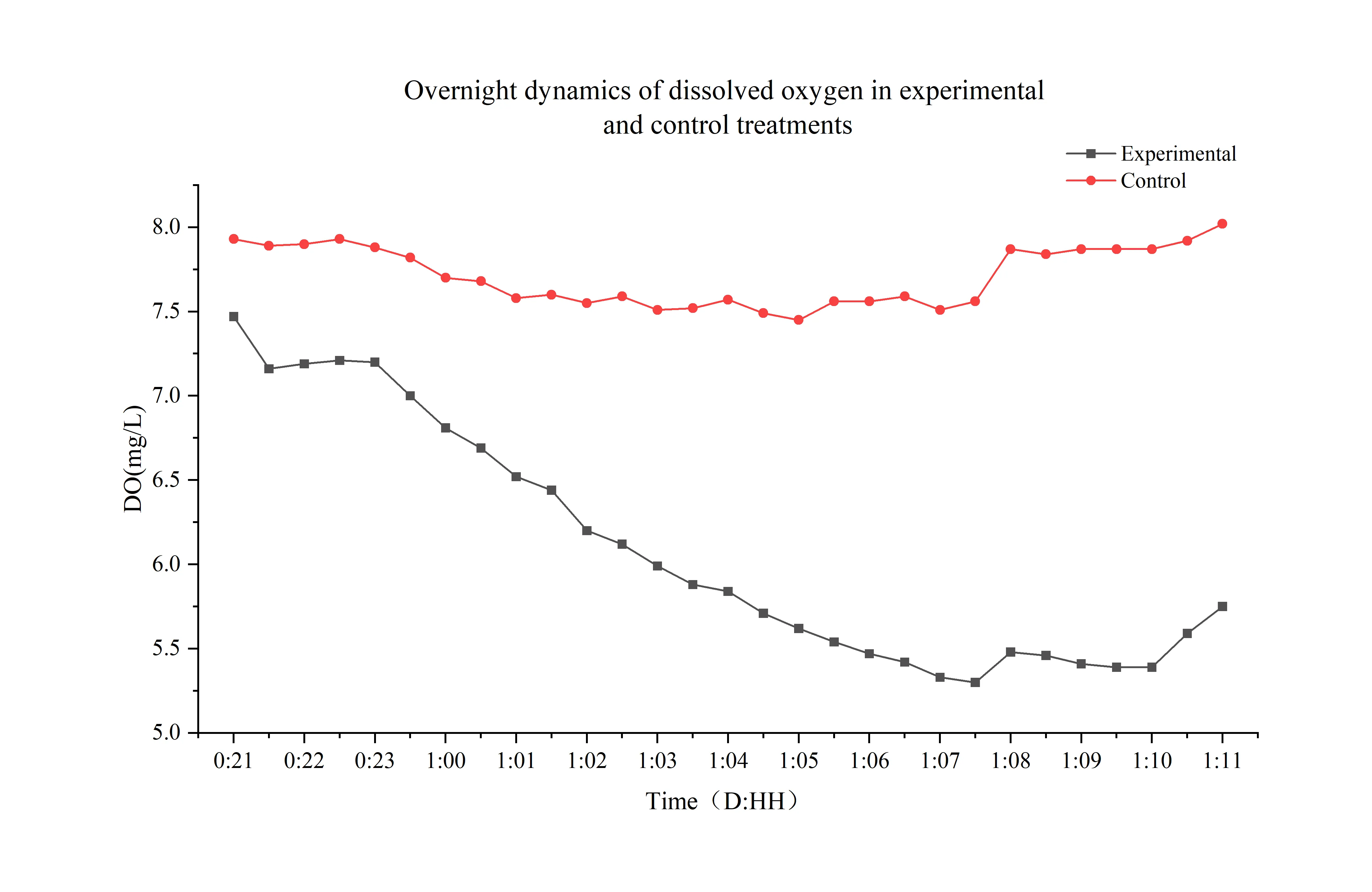
The study by Yuzha Laboratory, Dissolved Oxygen Dynamics and Hypoxia Risk in Night‑time Planted Aquariums, provides supporting evidence for this risk: under equivalent temperature and barometric‑pressure conditions, the blank‑control tank maintained stable dissolved‑oxygen levels of 7.45‑8.02 mg/L throughout the night. In the planted experimental tank, dissolved oxygen dropped continuously from 7.47 mg/L to a nightly minimum of 5.30 mg/L due to respiratory oxygen consumption by aquatic plants. With no light at night, photosynthesis ceases and aquatic plants only perform respiration, continuously consuming dissolved oxygen in the water body. Dissolved oxygen hits its daily low point in the early‑morning hours. Even without heavy waste excretion from fish and shrimp, the aquatic‑plant community alone is sufficient to cause a significant overnight drop in dissolved oxygen. This is the core reason why planted tanks face the highest risk of organism hypoxia in the early morning, making nighttime dissolved‑oxygen monitoring especially critical for planted aquariums.
5. Water Level and ATO Activity
Water level is the fastest daily signal that your auto top-off system is doing its job. Each morning, check that the ATO brought the level back once and then stopped. Since water level shifts usually show up in salinity first, this is an easy way to catch drift early [1].
Here are the main ATO fault patterns to watch for:
Red Flag | Likely Cause | Immediate Risk |
|---|---|---|
Rising top-off use | Leak or high evaporation | Reservoir empties fast; salinity drops |
No top-off activity | Sensor fault | Salinity spike |
Continuous pumping | Pump fault | Tank overflow; salinity crash |
ATO alarm sounding | Empty reservoir or pump timeout | System shutdown; salinity drift |
If you see the same pattern for more than a day, inspect the reservoir, tubing, and sensor before livestock pays the price.
A low sump pump chamber can also expose the return pump. When the water level drops too far, the pump may suck air, rattle, or run dry [1]. That’s the kind of small warning sign that can turn into a bigger mess if you miss it.
For day-to-day checks, look at the water line and give the ATO reservoir a quick glance. A sudden jump in top-off volume can point to a leak [1]. Check for wet tubing or damp spots inside the cabinet. If you log ATO volume over time, small leaks and higher evaporation become much easier to spot [1].
Use fresh water only for top-offs [1].
If water level looks steady, the next daily safety check is ammonia.
6. Ammonia
Ammonia is the most urgent chemistry check in a day-to-day tank routine because it can hurt fish before the aquarium shows obvious signs of trouble. It comes from waste and decay, and in any stocked aquarium, the daily goal is 0 ppm. Spikes can hit fast. A bit too much food, a dead fish or shrimp hidden out of sight, or disturbed biological filter media can send ammonia up within hours [2][3].
Ammonia can injure fish before visible stress appears, so daily testing is the only reliable early warning.
pH and temperature matter here. Higher pH and warmer water shift more ammonia into toxic NH3, which means even a small reading can be a big deal [3].
Common warning signs include:
- Clamped fins
- Lethargy
- Loss of appetite
- Cloudy water
- A fish that has disappeared and may have died [2][5][1]
For daily checks, strips are fine for a fast read. If something looks off, confirm it with a liquid test kit. If you want round-the-clock monitoring, connected sensors can send alerts as levels change.
If ammonia goes above 0 ppm, act fast: do a 20%–50% water change, stop feeding for 24 hours, and use an ammonia conditioner while the biofilter recovers [3][9]. After dosing an ammonia-binding conditioner, test with a salicylate-based liquid kit. Nessler-based kits can show false positives in that case [3].
If ammonia stays at zero but fish still seem stressed, check your equipment next.
7. Equipment Status
If your water chemistry looks steady but your livestock still seems off, the next place to look is your equipment.
Every aquarium settles into its own normal rhythm. You get used to the return pump’s hum, the heater light cycling on and off, and the usual flow from wavemakers and filters. That baseline matters. When one of those little patterns shifts, it often tells you something is wrong before the tank shows bigger signs.
A fast daily check of the return pump, wavemaker, and heater light can help you catch heater, pump, and flow issues early. Pay close attention to changes in heat, flow, alarms, and moisture. During that scan, check for new damp spots, drips, or salt creep around the cabinet, cords, and floor [1].
Some warning signs need fast action. A heater that never turns off is a livestock emergency [7]. Rattling or air in the return line can point to a blockage or air being pulled in [1]. And if a wavemaker stops pulsing and starts running in constant mode, that often points to biofilm buildup on the impeller. A dirty impeller can reduce flow long before the drop is easy to spot [9].
Equipment | Normal Daily Status | Red Flags |
|---|---|---|
Heater | Heater light cycles; temperature stays steady | Never turns off; short-cycling; temperature climbing unexpectedly |
Return Pump | Steady flow; quiet hum | Rattling; air bubbles in return line; reduced flow |
Wavemaker | Active pulsing; visible water movement | Constant mode only; grinding noise; weak flow |
Lights | On/off per schedule; all LEDs active | Flickering; dead LED clusters; controller time drift |
Controller / Sensors | Readings update; alerts arrive | Probe dropout; stale data; missed alarms |
Filter | Consistent output; clear intake | Blocked intake; unusual vibration or heat |
In multi-tank setups, cloud-connected logs and alerts can pull equipment status into one place, so failures show up sooner. That’s especially handy overnight or when you’re away, since a heater failure or pump shutdown can slip by without anyone noticing.
One last thing: don’t deep-clean the return pump and wavemaker on the same day. Doing both at once can disrupt biofiltration [9].
How Daily Trends Help You Diagnose Problems Faster
A single reading is just a snapshot. A trend tells you what’s actually going on. That’s why daily logs matter more than one-off readings.
The point of diagnosis is to spot patterns across several parameters, not stare at one number in isolation. In most cases, two to four weeks of logs is enough to show whether the system is steady or starting to drift. You don’t need more data for the sake of it. You need the right data so you can figure out problems faster.
The biggest clue often comes from combinations, not single readings. For example, rising salinity plus a falling water level usually points to evaporation or an ATO failure. But rising salinity with a stable water level suggests something else, like a bad sensor or the wrong water in the top-off reservoir [1][7].
The same idea applies to ammonia. If ammonia shows up within 48 hours of filter cleaning, the most likely cause is biofilter disruption. That makes sense when you remember where most nitrifying bacteria live: in the filter media [3][11]. Even small temperature shifts can add stress here. A change of just ±0.9°F over three consecutive days can stress nitrifying bacteria and may come before an ammonia spike [11].
pH trends deserve close attention too. A 0.2-unit pH drop over two weeks often signals low alkalinity and a growing organic load [11][3]. When that drop happens alongside falling KH, the warning gets much clearer.
These are the first pattern pairs to watch:
Parameter Combination | Likely Meaning | Recommended Action |
|---|---|---|
Rising salinity + dropping water level | Evaporation or ATO failure | Top off with fresh RO/DI water; check ATO reservoir [1] |
Rising salinity + stable water level | ATO sensor stuck or wrong reservoir fill | Inspect ATO sensor; verify reservoir contains fresh water [1][7] |
Ammonia spike + recent filter cleaning | Biofilter disruption | |
Falling pH + dropping KH | Depleted buffering capacity | Raise KH gradually [7] |
Write down the pattern, note what changed, and use that context to make your daily checks shorter and sharper. It’s usually safer to respond to a trend than to chase one bad reading. That’s how a daily routine turns from busywork into something you can act on.
A Simple Daily Check Routine for Home and Multi-Tank Setups
Keep the daily check short and repeatable. Five minutes is enough to catch drift before it turns into failure [1][2].
Stick to the same order each day: visual scan, feeding response, equipment, then readings. That simple sequence keeps the check fast and makes small changes easier to notice before they snowball.
Task | Time | What to Look For |
|---|---|---|
Visual Scan | 30 seconds | Fish behavior, water clarity, livestock/plant appearance, odors [1] |
Feeding | 1 minute | |
Equipment | 1 minute | |
Parameters | 1 minute | Temperature, water level/ATO status, live pH or ammonia sensors [1][3] |
For multi-tank setups, start with controller alerts and logs first. Then check only the tanks that show a change. That saves time, and a standard top-to-bottom scan order helps make sure no system gets skipped on a busy day [1][11].
Automation can keep things stable, but it can't read behavior. A fish that hangs back at feeding time or a tank that just looks off can tell you something a sensor won't. If a reading seems wrong, verify it by hand before you change anything [1][6].
Conclusion
Put together, these daily checks work like an early warning system, not just a log of numbers. These seven parameters matter because they can shift fast, and they can harm livestock before clear symptoms show up.
What separates a stable tank from one that starts slipping? Consistency. A steady tank usually does better than one that bounces around, even if those swings stay inside an “ideal” range.
That’s where connected monitoring comes in. It extends your awareness when you’re away from the tank and can flag temperature spikes, ATO faults, heater failures, and leaks before they turn into livestock losses or water damage.
The routine doesn’t need to be complicated. A five-minute daily check and steady logging are enough to catch drift early. The goal is simple: spot drift early, act fast, and stop small changes from turning into full-blown failures.
FAQs
Which parameter is most dangerous if it changes fast?
Temperature and ammonia are the two readings that can turn bad fast. If a heater fails and the tank temperature jumps, that’s an immediate emergency. And if you detect any ammonia in a stocked aquarium, treat it as serious right away.
Other water parameters, like alkalinity, salinity, and pH, still matter a lot. But those usually affect long-term health more than sudden survival, so they should usually be corrected slowly. If a reading looks off, test again before you make changes.
Do I need to test all seven parameters by hand every day?
No. You don’t need to test all seven parameters by hand every day.
If you’re cycling a new tank or making a big change, check key readings like ammonia and nitrite often, sometimes daily. Once the tank is established, most main parameters are usually tested weekly.
Some tools can also take a lot of the work off your plate. Digital thermometers, pH probes, and cloud-connected controllers can handle day-to-day monitoring in the background.
How can I tell the difference between a bad reading and a real problem?
Before you act on a suspicious reading, double-check it. Run the test again, make sure your equipment is calibrated, and confirm your reagents aren’t expired or contaminated.
Next, look at the tank itself for clues. Check equipment status, watch livestock behavior, and think about any recent changes. It also helps to compare the result against historical trends instead of reacting to one number in isolation.
Unless you’re dealing with an emergency, like heater failure or detectable ammonia, correct imbalances slowly.