Automatic Water Change
Automatic Water Change and Top-Up System: Making Aquarium Maintenance More Stable and Traceable
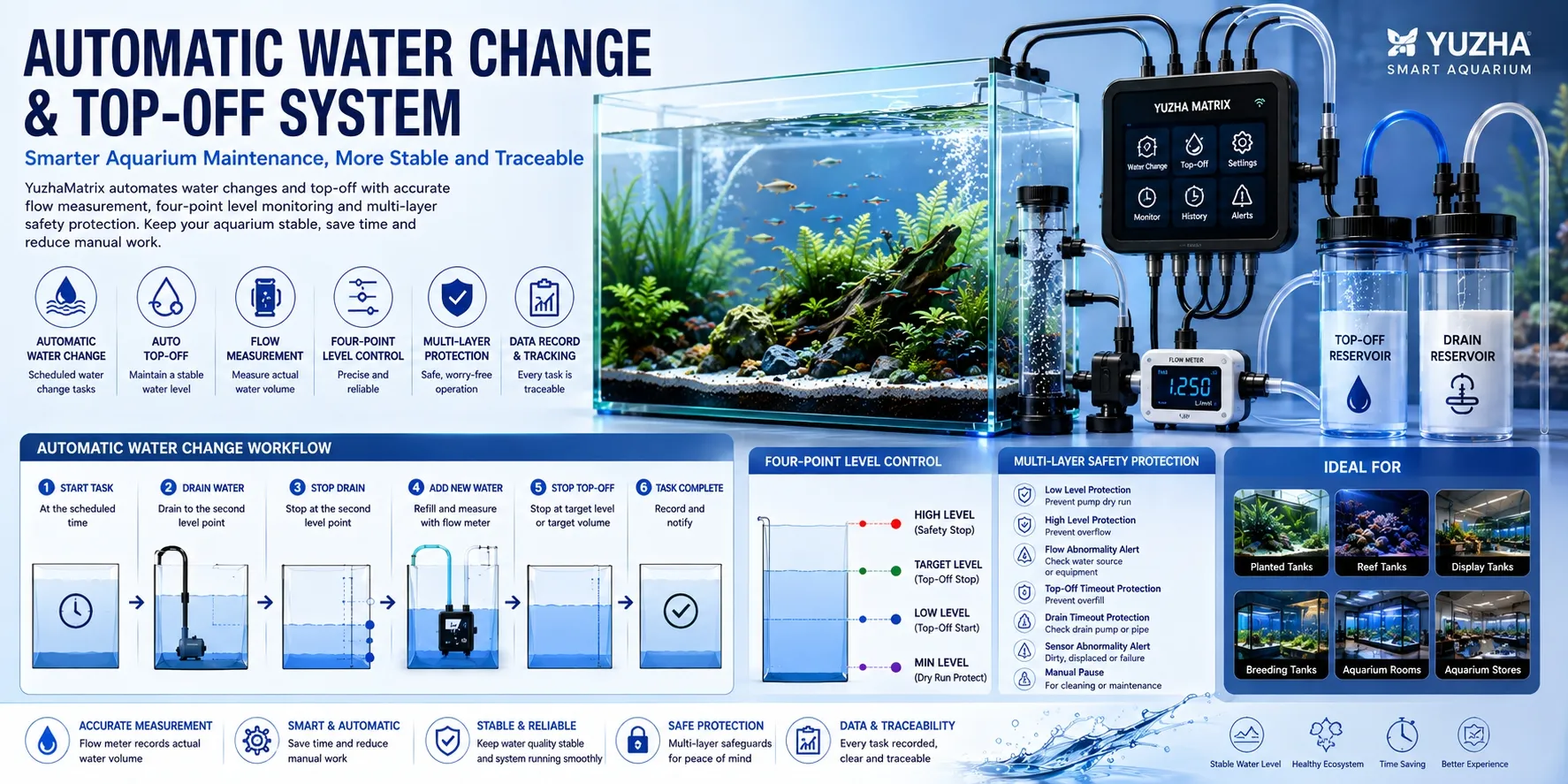
YuzhaMatrix Automatic Water Change and Top-Off System supports scheduled water changes, automatic top-off, refill-side flow measurement, and four-point water level protection. The system records the actual amount of new water added through the refill flow meter, while the four water level points manage low-water protection, drain-stop control, refill-stop control, and high-water protection. This helps aquariums and multi-tank fish rooms maintain safer, more stable, and more traceable water management.
In long-term operation of aquariums and professional fish rooms, water changes and top-ups are essential maintenance tasks for system stability. Traditional methods rely on manual draining and refilling, with water level judged visually. For multi-tank systems, commercial aquariums, breeding setups, or unattended fish rooms, this approach is time-consuming and prone to instability in water level, inconsistent water change volume, missed top-ups, pump dry-running, and human error.
Regular partial water changes help reduce accumulated nitrate and other dissolved waste compounds, reducing long-term water quality stress. In aquatic systems, ammonia and nitrite are primarily converted through biological filtration into nitrate, which is less toxic but gradually accumulates. Therefore, routine water changes remain a key strategy for maintaining water stability.[1][2]
The YuzhaMatrix automatic water change and top-up system transforms traditional manual maintenance into a programmable, measurable, monitorable, and traceable automated workflow through scheduled water changes, flow-meter-based top-up measurement, four-point water level monitoring, and safety protection logic.
1. System Operation Principle
YuzhaMatrix supports two modes: automatic top-up and automatic water change.
Automatic top-up compensates for daily evaporation losses, maintaining stable water levels in aquariums or sump systems.
Automatic water change performs scheduled water replacement according to user-defined timing, cycle, and target volume, improving water quality stability and reducing manual workload.
During water change, the system first drains old water and then refills with new water. Since the system uses a flow meter on the top-up line, the total water change volume is recorded based on the amount of new water added. In other words, YuzhaMatrix does not directly measure drained water but calculates water change volume based on measured incoming water.
2. Automatic Top-Up Logic
During normal operation, water level decreases due to evaporation. YuzhaMatrix continuously monitors water level via sensors and triggers top-up when levels drop below a set threshold.
Standard logic:
When water level reaches the second level point → start top-up.
When water level returns to the third level point → stop top-up.
If water rises to the fourth level point → immediately stop and trigger alarm.
If water drops below the first level point → low-water protection is activated to prevent pump dry-run.
This ensures stable water level maintenance with minimal manual intervention.
3. Automatic Water Change Logic
Users can configure timing, cycle, and target water volume.
Workflow:
At scheduled time → system enters water change mode.
Drain phase starts.
When water reaches second level point → draining stops.
Then system enters refill phase.
Top-up flow meter records incoming water volume.
When target volume is reached or third level point is reached → refill stops.
If water exceeds fourth level point → system stops immediately and triggers alarm.
During water change mode, second level acts as drain stop, third level as refill stop, while first and fourth levels serve as safety protection thresholds.
4. Four-Level Water Control
The system uses four water level thresholds:
Level 1: Minimum safety level — prevents pump dry-running.
Level 2: Drain stop / top-up start point depending on mode.
Level 3: Normal target level — refill stop point.
Level 4: High-level protection — prevents overflow.
Level sensors detect water height and provide control signals for pumps, valves, and alarms.[3]
5. Role of Flow Meter
The flow meter installed on the refill line measures actual incoming water volume. Flow meters can calculate both instantaneous and cumulative flow, making them suitable for volume-based control.[4]
During water change, the system tracks total refill volume until the target is reached.
Compared with time-based estimation, flow measurement reduces errors caused by pump aging, pressure changes, or pipeline resistance variation.
6. Coordination Between Flow Meter and Water Level Sensors
The system combines two control layers:
Flow meter ensures accurate water volume tracking.
Water level sensors ensure physical safety limits.
When target volume is reached → stop refill.
When level reaches threshold earlier → stop refill.
When overflow risk is detected → immediate shutdown.
If abnormal flow or no flow is detected → system triggers maintenance alert.
7. Safety Protection Mechanisms
Multiple protection mechanisms include:
Low-water protection (pump dry-run prevention)
High-water protection (overflow prevention)
Flow abnormality alarm
Timeout protection for refill and drainage
Sensor failure alerts
Manual pause mode for maintenance
8. Data Logging and Traceability
The system records each water change event, including start time, end time, volume, level changes, and alarms.
This allows users to analyze evaporation rate, detect leaks, and evaluate system stability across multiple tanks.
9. Application Scenarios
Suitable for planted tanks, display tanks, breeding tanks, quarantine systems, sump systems, fish rooms, and commercial aquarium setups.
10. Summary
The YuzhaMatrix system transforms manual water change operations into a fully automated, measurable, and traceable process.
Flow meters quantify actual refill volume, while four-point level sensors ensure operational safety.
Together, they enable stable, reliable, and scalable aquarium maintenance.
---
References
[1] RSPCA Knowledgebase. Why is water quality important in aquariums.
[2] RSPCA Knowledgebase. Aquarium fish care and nitrogen cycle overview.
[3] IQS Directory. Types of liquid level switches.
[4] ONO SOKKI. Flow measurement principles.
Start with YuzhaLink.
Register to use the cloud system, then choose devices that match the functions you need.