
CO₂ Automatic Control System
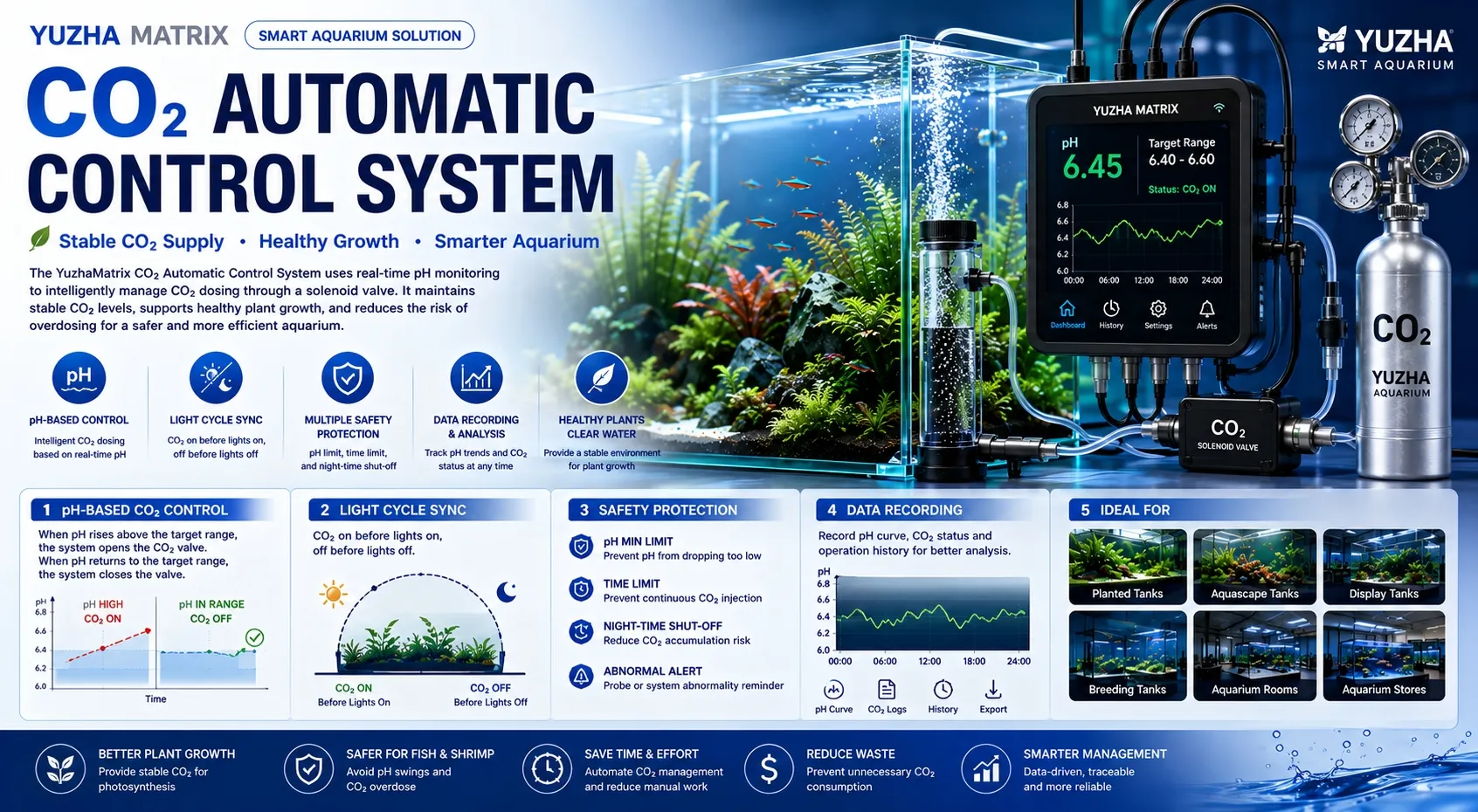
YuzhaMatrix CO₂ Automatic Control System supports pH-based CO₂ automation for planted aquariums, display tanks, multi-tank planted systems, and professional aquarium spaces. With real-time pH monitoring, the system can automatically control the CO₂ solenoid valve based on the user-defined target pH range. When pH rises above the target range, YuzhaMatrix activates CO₂ injection. When pH returns to the set range, the system automatically stops CO₂ supply, reducing manual adjustment and lowering the risk of excessive CO₂ accumulation. The system can also work with the lighting schedule, starting CO₂ before the lights turn on and stopping CO₂ before the lights turn off, better matching the photosynthesis cycle of aquatic plants. CO₂ control through pH is an indirect control method, not a direct measurement of dissolved CO₂ concentration. By combining pH monitoring with lower-limit protection, maximum runtime protection, nighttime shutoff, alerts, and historical data records, YuzhaMatrix makes CO₂ management more stable, safer, and traceable.
1. pH-Based CO₂ Automatic Control: Stabilizing CO₂ Supply in Planted Aquariums
In planted aquarium systems, CO₂ is one of the most important factors influencing plant growth. A sufficient and stable CO₂ supply provides the carbon source required for photosynthesis, helping aquatic plants maintain healthy growth under lighting conditions. For high-light, high-density planted tanks or long-term display aquariums, CO₂ stability is often more important than simply increasing dosage.
However, in practical maintenance, CO₂ regulation is not straightforward. Many users still rely on bubble counters to estimate CO₂ input and adjust based on plant condition, fish response, or personal experience. Bubble count only reflects the output of the CO₂ system and does not directly represent the actual dissolved CO₂ level in water. Due to differences in water flow, diffusion efficiency, KH, surface agitation, plant uptake rate, and water change frequency, identical bubble rates may still result in significantly different CO₂ levels in different tanks.
Therefore, YuzhaMatrix adopts a more practical approach: real-time pH monitoring is used to indirectly evaluate CO₂ status and automatically control the CO₂ solenoid valve.
2. Relationship Between CO₂, pH, and KH
When CO₂ dissolves in water, it participates in the carbonate equilibrium system and affects pH. Under relatively stable conditions, increased CO₂ typically leads to a decrease in pH, while reduced CO₂ supply or consumption by plants leads to a gradual increase in pH [1][2].
Carbonate hardness (KH) reflects the buffering capacity of water against rapid pH changes and is mainly associated with bicarbonates, carbonates, and hydroxides [1]. Therefore, in a planted aquarium with relatively stable KH, pH variation can serve as an indirect indicator of CO₂ levels.
It should be noted that this is an indirect method rather than a direct measurement of dissolved CO₂ concentration. Actual CO₂ levels are also influenced by KH, temperature, aeration, water movement, diffusion efficiency, and plant uptake rate [2].
3. How YuzhaMatrix Controls CO₂
Users can set a target pH range in the YuzhaMatrix system. The system continuously reads pH probe data and determines whether CO₂ supplementation is required.
- When pH rises above the target range, the system assumes CO₂ is insufficient and opens the CO₂ solenoid valve.
- When pH returns to the target range, the system closes the CO₂ solenoid valve to prevent over-accumulation.
In this way, CO₂ dosing is no longer dependent solely on manual bubble adjustment but is managed through automated pH-based feedback. This improves stability, control, and traceability in long-term aquarium operation.
4. Integration with Lighting Cycles
Aquatic plants consume CO₂ primarily during the photoperiod. During light periods, plants perform photosynthesis and consume inorganic carbon; at night, photosynthesis stops, and continued CO₂ injection may lead to waste and stress for fish and shrimp. pH also naturally fluctuates with day-night biological activity [2][3].
YuzhaMatrix supports synchronization between CO₂ control and lighting cycles. The system can pre-inject CO₂ before lights turn on so that water conditions stabilize before the photoperiod begins. It can also stop CO₂ injection before lights turn off to reduce nighttime accumulation.
This coordination allows CO₂ delivery to follow the biological rhythm of aquatic plants rather than relying on fixed schedules.
5. Safety Protection Mechanisms
Although CO₂ benefits plant growth, excessive CO₂ can cause rapid pH drops and stress aquatic animals. Aquaculture studies show that CO₂, pH, alkalinity, and hardness are closely linked and significantly affect fish health and system stability [2].
Therefore, multiple safety mechanisms are included in the YuzhaMatrix CO₂ control system:
- A minimum pH threshold can be set. When pH falls below the safety limit, the system automatically closes the CO₂ valve.
- A maximum injection duration can be configured. If CO₂ remains active for too long, the system alerts users to check diffusion efficiency, gas supply, solenoid valve, or pH probe status.
- Night-time CO₂ shutdown is supported to reduce unnecessary consumption and prevent accumulation.
6. Data Logging for Smarter Control
Traditional CO₂ adjustment relies heavily on experience and lacks objective feedback. YuzhaMatrix records pH curves, CO₂ activation duration, shutdown times, and alert logs.
Users can analyze historical data to observe:
- Whether CO₂ stabilizes before the photoperiod
- Whether pH fluctuates excessively during lighting
- Whether CO₂ remains active for too long
- Whether diffusion efficiency declines
- Whether water changes cause abnormal pH shifts
These records help users better understand system behavior instead of relying solely on visual observation or short-term judgment.
7. Important Notes
pH-based CO₂ control is an indirect control method. It relies on the relationship between pH and the carbonate buffering system and does not directly measure dissolved CO₂ concentration. In systems with unstable KH, frequent acid additions, large water changes, or low buffering capacity, the relationship between pH and CO₂ may become unstable [1][2].
Therefore, users should maintain relatively stable KH and regularly calibrate pH probes. For sensitive livestock systems, more conservative safety thresholds and CO₂ timing limits are recommended.
The goal of YuzhaMatrix is not to maximize CO₂ concentration, but to ensure stable, safe, and controllable CO₂ delivery within a biological system.
8. Summary
YuzhaMatrix transforms traditional experience-based CO₂ adjustment into an automated control system based on real-time pH monitoring.
It helps maintain stable CO₂ supply in planted aquariums, reduces manual intervention, lowers the risk of over-dosing, and provides historical data for system analysis.
For planted tanks, display aquariums, multi-tank systems, and professional aquascaping setups, pH-based CO₂ automation is an important feature for improving long-term stability.
---
References
[1] U.S. Geological Survey. Alkalinity and Water. Explains buffering capacity of water and carbonate system relationships.
[2] Wurts, W. A., & Durborow, R. M. Interactions of pH, Carbon Dioxide, Alkalinity and Hardness in Fish Ponds. SRAC Publication No. 464.
[3] FAO. Water Quality and Fish Health.
Start with YuzhaLink.
Register to use the cloud system, then choose devices that match the functions you need.