Skip to content
YuzhaLink

Product notes

Hands-on notes from building and living with our hardware — setup, tuning, and the trade-offs we made along the way.

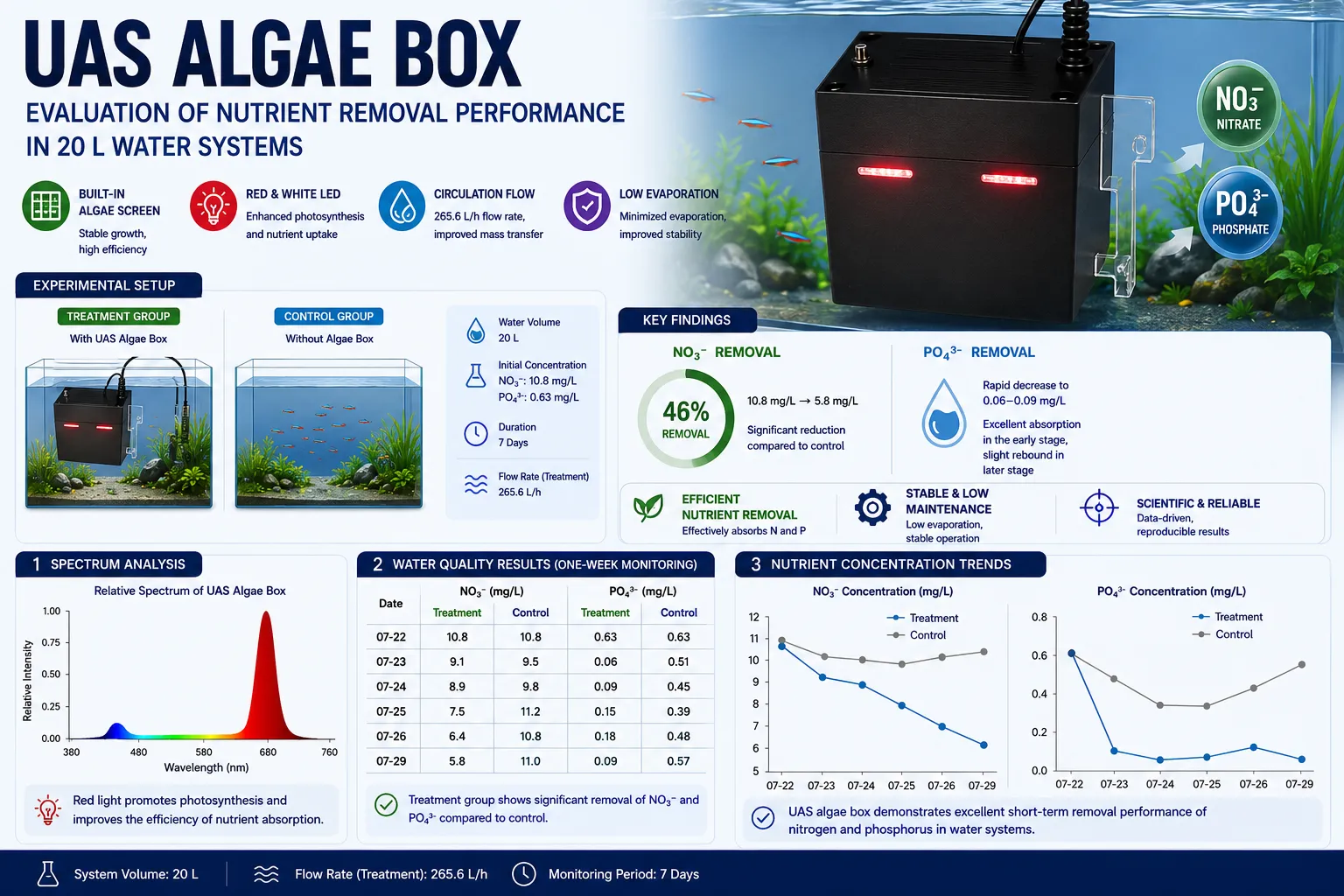
Infographic evaluating a UAS algae box in a 20 L aquarium: the black box unit mounted on a tank rim with red LEDs lit, a treatment-versus-control setup diagram, a measured spectrum with a dominant red peak, a one-week water-quality table, and trend charts showing nitrate falling from 10.8 to 5.8 mg/L (46% removal) while phosphate drops to 0.06–0.09 mg/L.

Review

Nitrate and Phosphate Removal by a UAS Algae Box in a 20 L System

A UAS algae box — an enclosed algae scrubber with internal algae screens and its own LED lighting — was run against a no-box control in matched 20 L tanks for one week. Nitrate in the treatment tank fell from 10.8 mg/L to 5.8 mg/L, about 46%, while the control drifted between 9.5 and 11.2 mg/L with no downward trend. Phosphate fell much faster, from 0.63 mg/L to 0.06 mg/L within a day, then drifted back up to 0.18 mg/L mid-week before easing to 0.09 — most likely phosphorus released as algal debris and surface deposits broke down. The practical consequence is that the screens have to be harvested on a schedule: left to accumulate, the box begins returning nutrients it removed earlier. One treatment tank and one control, six sampling points across seven days, and a single pump flow of 265.6 L/h — trend data, not a validated removal rate.

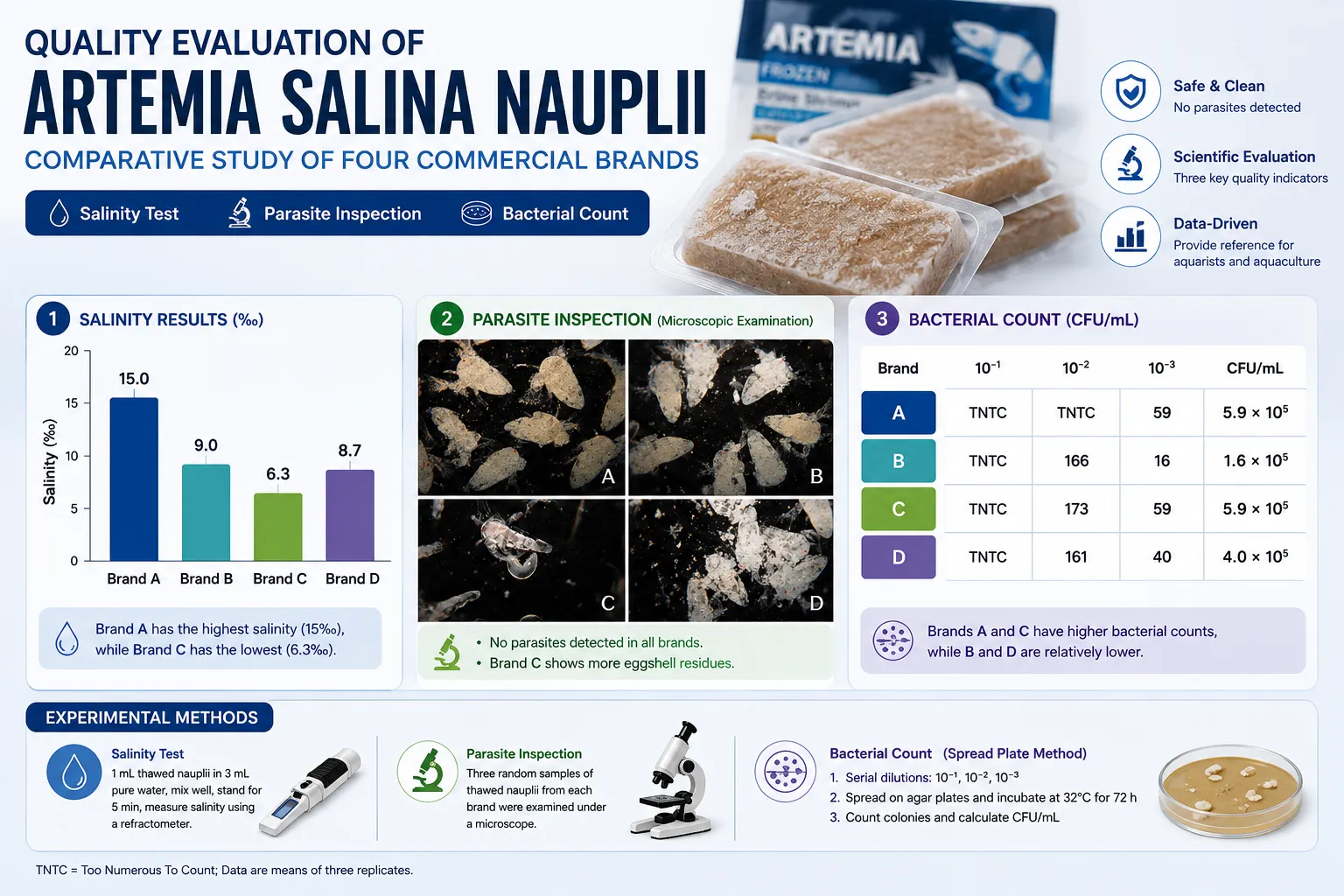
Infographic summarising a quality evaluation of Artemia salina nauplii from four commercial brands: a bar chart of mean salinity (A 15.0‰, B 9.0‰, C 6.3‰, D 8.7‰), a four-panel microscopy inspection reporting no parasites, and a table of bacterial counts from 1.6×10⁵ to 5.9×10⁵ CFU/mL, beside frozen blister packs of brine shrimp.

Review

Comparative Evaluation of Artemia salina Nauplii from Four Commercial Brands: Salinity, Parasites and Bacterial Load

Four commercial brands of Artemia salina nauplii were tested for salinity, parasites and bacterial load. No parasites were found in any brand, so the basic sanitary claims hold up. But every brand carried bacteria of the same order of magnitude — from 1.6×10⁵ CFU/mL for the lowest to 5.9×10⁵ CFU/mL for the highest — suggesting that "fully disinfected" marketing does not survive storage and transport. Salinity varied more than expected, from 15‰ down to 6.3‰, and the lowest-salinity brand also showed heavy chorion residue and visible blank ice, pointing to high water content and incomplete processing. At the dilution actually used when feeding, the salt added to tank water is negligible. Three replicates per brand, cultivable bacteria only, and brands are anonymised as A–D.